
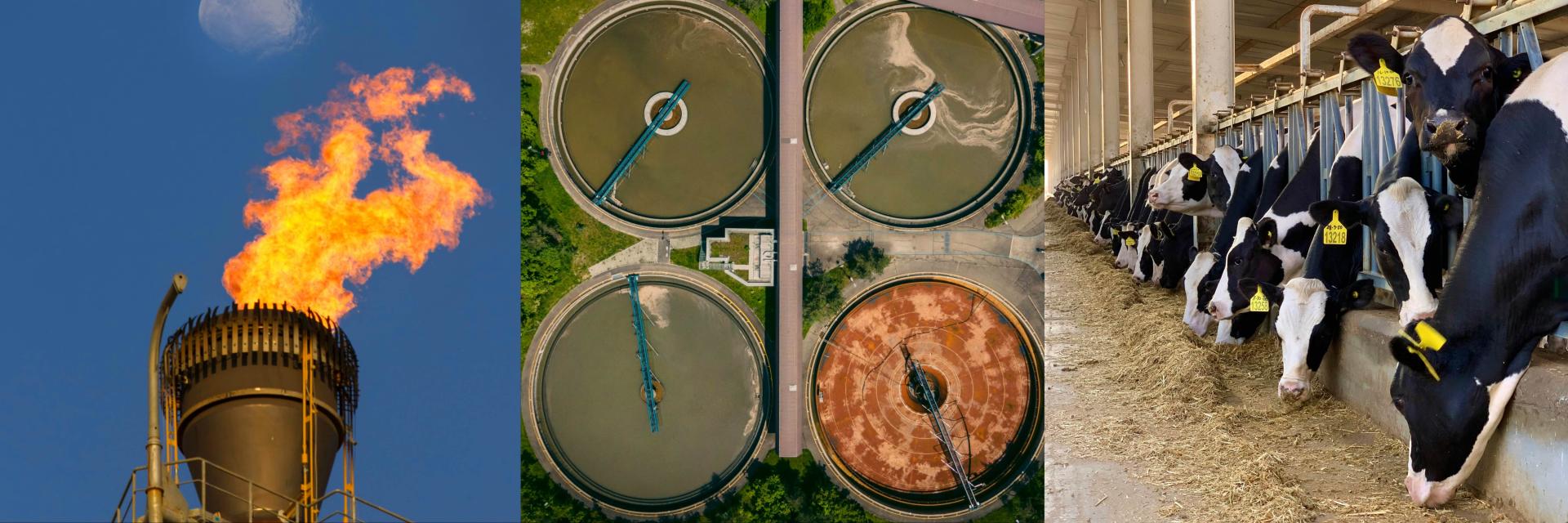
From Left to Right: Natural Gas Flare | Waste Water Treatment Plant | Dairy Cows.
Credit: Matin Tavazoei / Suvrajit S / Patrick Federi on UnsplashMethane
Advance strategies and technologies that detect, prevent, and mitigate anthropogenic releases of methane into the atmosphere across the agriculture, energy, and waste sectors.
Methane (CH4) is a gas with over 80x more warming potential than carbon dioxide (CO2) over a 20-year period. However, since CH4 has a significantly shorter atmospheric lifespan than CO2, rapid reductions in CH4 emissions would have a noticeable short-term impact on global temperatures. Anthropogenic CH4 emissions primarily stem from agriculture and the oil and gas (O&G) industries, as well as from coal, landfills, and wastewater, collectively accounting for ~30% of anthropogenic global warming. To curb agricultural CH4, prioritize feed additives, selective breeding, and manure management for livestock, and alternate wetting and drying (AWD), low CH4 varieties, and straw/residue management for rice. In the O&G sector, prioritize Leak Detection and Repair (LDAR) programs that use ground, drone/aerial, satellite, and AI-powered tools to detect leaks in real time, replace faulty valves, seals, and pipes, and optimize operations to reduce venting and flaring. Vigilant maintenance, emissions control devices, and smart metering will help minimize releases. Additionally, the use of digesters, landfill gas capture (LFG) systems, and capturing ventilation air methane (VAM) from coal mines can not only curb significant CH4 emissions but also produce renewable natural gas (RNG), which requires no drilling or fracking. The IEA and EPA promote regulations, incentives, and voluntary initiatives such as the Global Methane Pledge that aim for substantial emissions reductions, economic gains, job creation, and reduced air pollutants. By swiftly tackling CH4 emissions through sensible policies, regulatory standards, innovative solutions, and systemic change, we can curb this potent GHG and build a cleaner, healthier world.



Action Items
Individuals
Learn about the sources of anthropogenic and natural methane (CH4) emissions. CH4 is a significant driver of near-term climate warming, accelerating environmental degradation and health risks worldwide. Reducing CH4 emissions from anthropogenic sources is essential.
- CH4 is over 80x more potent than CO2 over a 20-year period, rapidly trapping heat and contributing to about ~30% of human-caused global warming, with its atmospheric concentration at 2.5x pre-industrial levels.
- The primary sources of anthropogenic CH4 emissions are from agriculture (ruminants and rice; ~40%) and the energy sector (oil, gas, coal, bioenergy; ~35%), with leaks predominantly occurring during extraction, transportation, and storage. Landfills and wastewater account for ~25% of anthropogenic CH4 (landfills and wastewater; ~25%).
- Natural/geological sources of CH4 emissions include wetlands, marine seeps, land seeps (and “microseepage”), geothermal/volcanic activity, and gas hydrates. Altogether, natural sources make up ~35% of the methane budget, the largest contributor of which is wetlands (~28% of the total budget). See Wetlands Nexus and Tidal Salt Marshes Nexus.
Learn about the health and environmental impacts. CH4 has a direct role in forming tropospheric ozone as well as smog, which is a mix of ozone, nitric oxide (NOx), sulfur dioxide (SO2), particulate matter (PM), and volatile organic compounds (VOCs). Both ozone and smog increase the risk of respiratory diseases like asthma and bronchitis, and chronic obstructive pulmonary disease (COPD). Other impacts include hydraulic fracturing contaminating groundwater, CH4 leaks killing trees, explosions in residential homes, and leaks directly affecting vulnerable communities near natural gas facilities.
Check gas appliances for leaks. Gas appliances leak CH4 and NOx during use and even when turned off. In a study of 481 homes, 4% had large enough leaks that regular use of the appliances resulted in elevated CH4 and NOx throughout the interior living space. Benzene (a VOC) is a known carcinogen found in 97% of natural gas samples. Additionally, the combustion of natural gas in appliances produces NOx and VOCs, all of which are bad for your cardiovascular and respiratory health. Annual gas checks are recommended; contact your local utility company, as many of them offer inspections for free. You can also get natural gas detectors for your home, and make sure to keep outside air flowing to avoid stale air.
Replace gas appliances. Changing to electric appliances will improve indoor air quality, reduce CH4 leaks, GHG emissions, and save on your energy bill. Induction stoves are 3x more efficient, and heat pumps 3-4x more energy efficient than their gas or standard electric counterparts. The average U.S. household can cut its heating-related climate pollution by 45-72% by switching to a heat pump. Many countries, including the U.S. and Canada, offer rebates, tax credits, and other incentives for electrifying homes. Ecuador upgraded 750,000 homes to induction stoves using an incentive program from 2015-2021, reducing residential emissions by 7% (with hospitalizations declining in lockstep). See Electrify Everything Nexus, Heat Pumps Nexus, and Buildings Nexus.
Reduce your intake of meat and dairy, especially from industrial sources. Ruminant animal-based agriculture is responsible for ~30% anthropogenic CH4 emissions due to enteric fermentation and manure, with beef cattle making up ~70% of these emissions. Concentrated animal feeding operations (CAFOs) necessarily create larger manure lagoons, disproportionately increasing the amount of CH4 emitted. Instead, support farms using regenerative practices like rotational grazing, which helps reduce CH4 emissions by spreading out the manure (to increase oxidation and prevent anaerobic digestion) and sequesters more carbon by giving grasses rest periods to develop deeper root systems. Check out this Regenerative Farm Map to support farms using these practices, and see Regenerative Agriculture Nexus, Localization Nexus, and Plant Diversity Nexus.
Start a composting system at home. Compost adds organic matter and nutrients to soil, boosting microbial activity and improving structure. When you don’t compost and dispose of the waste, that material ends up in a landfill (which accounts for ~12% of global anthropogenic CH4 emissions), and it decomposes anaerobically, releasing more CH4 as a byproduct. Though composting at home does release CO2, it mitigates as much as 78% of the CH4 emitted at a landfill. Healthy soil and plant life will offset the CO2 emissions via natural carbon sequestration. For even more benefits, try adding worms to your compost. See Compost Nexus and Vermiculture Nexus.
Prioritize walking, biking, micromobility, public transportation, carpooling, minimize air travel, and upgrade to an EV. The transportation sector is responsible for ~1% of anthropogenic CH4 emissions. By prioritizing other means of transportation, one can reduce tailpipe, GHG, and particulate emissions, and reduce traffic. See Micromobility Nexus, Urban Mobility Nexus, Net Zero Cities Nexus, Fifteen Minute Cities Nexus, and Electric Vehicles Nexus.
Support initiatives and organizations that target anthropogenic CH4 sources. While indirect, individuals can sign petitions to limit CH4 (U.S.), reject the expansion of hydrocarbon energy projects (AU), support stronger CH4 reduction policies (Canada), and end factory farming (Global). Support or volunteer with NGOs like the Environmental Defense Fund, Methane Matters, the UN Environment Programme, and Compassion in World Farming.
Groups
Ruminant Farmers and Ranchers
Use CH4-reducing feed additives. Novel feed supplements like 3-nitrooxypropanol (3-NOP), red seaweed (Asparagopsis), and Enterix (garlic and citrus extract) added to the daily feed inhibit methanogenesis. These can cut emissions by up to 80% while improving feed efficiency. However, methanogenesis is a significant and necessary metabolic process in ruminants, so feeds should be measured and monitored closely. Additionally, production of these supplements is still limited, can be cost-prohibitive for small producers, and more data is needed to deploy at scale. See Asparagopsis Nexus.
Selective breeding for lower CH4 livestock. Choose breeding stock with genetic traits for more efficient digestion, leading to 20-30% less CH4 by 2050. Programs in New Zealand have cut sheep emissions by 11%, and similar efforts for cows are underway in the U.S. and Canada, utilizing genomic tests without productivity loss.
Improve manure management. Cover lagoons or use digesters to capture CH4 and turn it into biogas for farm energy. This can reduce emissions by as much as 50-80%. For manure solids, compost them or add materials like biochar to lock in the gas, which can reduce emissions by over 80% (depending on the form of biochar). As an added benefit, this also reduces odors and improves soil health. For more information, the EPA has extensive guidance on manure CH4 reduction practices. See Biogas Nexus and Biochar Nexus.
Use digital tools, apps, and AI. Tools like CowManager (U.S./EU) or Nedap Livestock (Global) fine-tune diets for emission reductions when using 3-NOP, Asparagopsis, or Enterix feed additives. In Australia, there is the Net Zero Agriculture Pathfinder, a free digital toolset offering farm-specific plans for CH4 cuts, as well as DataFarming, which specializes in digital agronomy tools. There’s also Holos (Canada) and Farmtopia (EU).
Rice Farmers and Producers
Alternate wetting and drying (AWD) for rice. Instead of keeping fields flooded all season, allow the water level to drop periodically to oxygenate the soil, starving methanogenic bacteria. This slashes CH4 emissions by 30-70% and saves up to 30% on water. Use inexpensive tools like perforated pipes to monitor water levels, and pair them with deep-placed fertilizers (nutrients placed several inches beneath the soil’s surface) to avoid other GHGs like nitrous oxide (NOx), which can be reduced by up to 70% with these solutions. This is an increasingly popular practice in Asia due to frequent high water stress. See Systems of Rice Intensification Nexus.
Switch to low-CH4 hybrid rice varieties. Rice roots contain organic chemical compounds called exudates that are metabolized by methanogenic bacteria. By reducing these organic compounds, such as furmarate, and increasing ethanol (which suppresses methanogenic bacterial growth), scientists have created a non-GMO low-fumarate high-ethanol (LFHE) strain that reduces emissions by up to 70% without compromising on yields. In fact, these crops produced 8.96 tons per hectare, compared to the global average of 4.71 tons per hectare. Many rice strains are still in development, but RiceTec (U.S., India, Mercosur) has a commercially available product.
Improve rice straw and residue management. Anaerobic digestion of rice straw is a key source of CH4 from rice producers, and it’s frequently burned instead of repurposed. By composting or converting rice straw into biochar, rice straw CH4 emissions can be reduced up to 80-90%. Rice straw biochar can then be added back to the field, not only improving soil aeration and carbon sequestration, but also soil fertility. Another option is no-till machines that chop, mix, and incorporate rice straw into the soil while sowing rice or wheat. See Compost Nexus and Biochar Nexus.
Fertilizer optimisation. Conscientious management of nitrogen fertilizers helps reduce CH4 from rice fields (~25-30%) by avoiding excess nutrients that feed methanogenic bacteria in anaerobic conditions, while also reducing another highly potent greenhouse gas, nitrogen dioxide (N2O). Opt for slow-release options like neem-coated urea (NCU), which can lower CH4 and N2O production.
Change to integrated aquaculture. Rice-fish farming is a regenerative practice that uses species such as carp, tilapia, or rohu to forage and oxygenate the water naturally. This aerates the soil and disrupts CH4 hotspots. In a trial run by the University of Arkansas with local rice farmers, integrated aquaculture systems cut CH4 emissions by 55% in those trial locations. In another trial in South China, integrated aquaculture systems cut N2O emissions by up to 28.2%. Other examples show CH4 and N2O reductions. Additional benefits include reduced fertilizer inputs, less nitrogen runoff, natural weed and pest suppression, and supplementary income from fish sales, all without compromising rice yield. See Aquaculture Nexus.
Incorporate Azolla ferns. Azolla is a floating aquatic plant that naturally fixes nitrogen from the air (biofertilizer), reducing synthetic fertilizer needs by 25%. It also lowers CH4 emissions by 25% compared with conventional rice cropping by increasing oxygen levels (thereby suppressing CH4-producing conditions). More impressively, it can boost rice yields up to 36% while suppressing weeds, enhancing soil organic carbon, curbing mosquito populations (by covering water surfaces), and helping conserve water by preventing evaporation. See The Azolla Foundation and Azolla Fern Nexus.
Use digital tools, apps, and AI. Leveraging digital tools enables the precise management of water and nutrients, which are key to reducing CH4 emissions. These tools are still developing and may not be available in all areas.
- BASF's xarvio (Asia, EU, Americas) provides digital farming tools, delivering field and zone-specific recommendations that improve yields and reduce costs. In Japan, the Healthy Fields outcome-based agricultural service shows impressive results, including up to 85% CH4 emission reductions.
- IRRI's RiceMoRe (Vietnam) integrates real-time data for monitoring rice activities, enabling the measurement, reporting, and verification (MRV) of emissions and supporting low-emission strategies, such as the One Million Hectares Program.
Data Researchers and Technologists
Develop better monitoring tools. Recent innovations include low-cost IoT sensors and drone-based Gas Mapping LiDAR® (GML) systems. MethaneSAT, a satellite that creates high-resolution emission heatmaps, supports daily O&G production basin scans. Integrate AI with these tools for automated plume detection to enhance Leak Detection and Repair (LDAR) efficiency.
Utilize and build collaborative data platforms. Great examples include the EDF’s Methane Map, Google’s Earth Engine, and UNEP’s International Methane Emission Observatory. These datasets are critical for LDAR programs to address O&G industry CH4 leaks, but also for modeling emissions of natural sources such as wetlands.
Focus on urban hotspot mapping. Use mobile Cavity Ring-Down Spectroscopy (CRDS) coupled with isotope analysis for more accurate source attribution (biogenic vs thermogenic), with AI to identify high-emission sites.
Companies
Oil & Gas Companies
Use multi-tech leak detection and repair (LDAR) programs, upgrade existing infrastructure, and optimize flaring and venting. With stricter regulations around CH4 leaks, increased press demonstrating the scale of the problem, significant financial losses from wasted natural gas, and negative public perception due to environmental impacts, O&G companies have many incentives to improve their operations. The IEA estimates that up to 75% of O&G CH4 emissions can be mitigated with current technology, with 50% at no or little cost. Implement frequent surveys using drones, aerial surveys, satellites, optical gas imaging (OGI) cameras, and low-cost infrared tools to detect and repair leaks. Utilize high-efficiency flares (>99% combustion), install vapor recovery units (VRUs) to capture vented gas, replace natural gas-powered pneumatic controllers with instrument air controllers and high-bleed valves with electro-pneumatic models, implement flare-combustion monitoring systems, and utilize digital flare mitigation with AI.
- TotalEnergies achieved zero routine flaring in its Nigerian operations with its OML 100 Flare Out project, which is part of its commitment to stop all routine flaring by 2030.
- BP's BPX Energy (U.S.) achieved zero routine flaring ahead of its 2025 goal via infrastructure upgrades like enhanced flare controls and venting reductions, with overall CH4 intensity reaching 0.07% in 2024.
- ExxonMobil implemented continuous, 24/7 LDAR monitoring in the Permian Basin with drones, satellites, aerial surveys, and fixed sensors, alongside their Center for Operations and Methane Emissions Tracking (COMET) for data analysis. These efforts, paired with infrastructure upgrades, have cut CH4 intensity by <60% from 2016 to 2024, and aim to achieve 70-80% by 2030.
- Chevron rolled out LDAR using optical gas imaging and compressed air pneumatics, alongside vapor recovery units. These measures reduced CH4 emissions intensity by ~50% in areas like the Permian Basin since 2016, and they aim to achieve zero flaring by 2030.
Utilize available financing and incentive programs for rapid CH4 emission reductions. By leveraging these programs, O&G companies can effectively deploy advanced technologies, such as AI-powered leak detection and infrastructure upgrades, resulting in a reduction of up to 75% in CH4 emissions across the entire industry.
- United States - O&G companies can access $1.36 billion in federal funding through the Inflation Reduction Act's Methane Emissions Reduction Program (MERP) to monitor, measure, and abate CH4 emissions.
- Canada - The Emissions Reduction Fund (ERF) Onshore Program offers $675 million in repayable contributions for CH4 abatement projects, such as venting/flaring reductions and equipment upgrades. There are also provincial incentives, like Alberta's $78 million in grants for monitoring, managing, and reducing CH4 emissions.
- Australia - O&G companies can apply through eligible research organizations to the Resources Methane Abatement Fund, offering $1–5 million per project for developing, prototyping, and demonstrating CH4 abatement tech.
Follow best practice guides and use third-party auditing, verification, and certification. The O&G industry has demonstrated consistent issues when it comes to underreported CH4 leaks. In the U.S., O&G CH4 emissions are estimated to be 4x times higher than EPA reports and 8x above industry targets. 12 major oil-producing regions exhibit significant disparities, with CH4 leaks wasting natural gas worth tens of billions. Third-party auditing addresses self-reporting biases that can significantly underestimate CH4 emissions. Implement guidelines from organizations like the Oil and Gas Climate Initiative (OGCI), UNECE, and the Global Methane Initiative.
- MiQ Certification offers letter-graded assessments of CH4 intensity, monitoring technology, and abatement strategies, with audits performed by accredited firms such as Intertek or SGS.
- Project Canary offers the “most sophisticated” emissions software platform for the O&G sector. TrustWell, its certification arm, offers facility-level certification through continuous sensor monitoring and ESG scoring.
- Equitable Origin’s EO100 is the world's first comprehensive voluntary certification system for energy projects, emphasizing social and environmental leadership in the O&G industry and covering the entire ESG spectrum.
- UNEP’s OGMP 2.0 Framework is the only comprehensive, measurement-based reporting framework for the O&G industry. It offers five reporting levels, granting a gold standard to levels 4 and 5.
Biogas and Waste Management Companies
Deploy anaerobic digesters at farms and wastewater facilities. Install digesters to process manure, food waste, and sewage sludge, capturing CH4 for biogas production. Focus on high-emission sites like dairy farms (providing profits from energy sales or digestate as fertilizer) or municipal treatment plants. See Biogas Nexus.
- Digesters equipped with combined heat and power (CHP) engines or microturbines can convert captured biogas into electricity and heat, which can either be used onsite (for lights, pumps, fans, refrigeration, space or water heating, etc.) or injected into the grid. This boosts energy independence and profits for farmers.
- Combine photovoltaic power arrays with battery storage for hybrid energy production, which helps ensure stable energy output during low-biogas production periods and reduces cost per kWh. See Solar Nexus.
Implement landfill gas (LFG) collection systems. Install gas wells to capture LFG, which is typically 50/50 CH4/CO2. This will collect 60-90% of the CH4 of LFG, which can be converted into renewable natural gas (RNG).
Governance
Mandate comprehensive LDAR programs and MRV systems. The U.S. EPA issued a final rule to reduce CH4 in 2023, with the EU following in 2024, but more countries need to follow these examples. Require O&G companies to use tools such as drones, aerial surveys, satellites, optical gas imaging (OGI) cameras, and low-cost infrared tools to detect leaks and impose fines if not addressed within a reasonable time period (e.g., 30 days). Combine these solutions with robust monitoring, reporting, and verification (MRV) systems, which will build trust and accuracy in emission data and enable better policy decisions and accountability.
Impose emission standards, limits, and bans. Impose caps on venting and flaring that align with the World Bank's Zero Routine Flaring by 2030 goal, which is endorsed by 36 governments and 60 oil companies. For example, the U.S. has imposed fines of $900 per metric ton of CH4 exceeding a 0.2% intensity threshold, which jumped to $1,200 in 2025, and goes up to $1,500 in 2026 (though the Trump administration has delayed this). Canada’s 2018 CH4 regulations for the O&G sector were updated in 2023, and ban intentional venting except for safety, require studies for non-emergency flaring, and mandate quarterly/annual inspections.
Mandate digesters and LFG systems. Digesters installed within a manure lagoon can achieve 82% CH4 emission reductions, and landfill gas capture (LFG) systems up to 75%. In addition to the significant air quality and health improvements (and numerous other benefits), these solutions at scale can provide renewable natural gas (RNG) that can offset 0.74% of U.S. demand.
Offer incentives and subsidies in tandem with mandates. Financial tools can help lower the barriers to entry for adopting CH4-reduction technologies. Offer tax credits/deductions, grants and subsidies, performance-based incentives, and low-interest loans. For example, the Methane Reduction and Economic Growth Act (2025) proposes adding a provision allowing a credit for capturing qualified CH4 from mining activities.
Agree to and uphold global pledges and set international standards. Commitments include the Global Methane Pledge for 30% reductions by 2030 or the EU Methane Strategy, which promotes technology sharing and regulatory alignment. Utilizing UNEP’s OGMP 2.0 Framework will help create consistent transparency, enabling an international standard regarding fines or other consequences for failures to report accurately.
Foster multilateral cooperation. Partnerships can help accelerate the implementation of methane-abatement strategies and address supply-chain vulnerabilities. More coalitions, such as the Joint Statement on Accelerating Methane Mitigation from the Liquefied Natural Gas (LNG) Value Chain (U.S., SK, AU, EU, and JP), are also needed. Hosting high-level forums, such as the COP 29 Global Methane Pledge Ministerial, helps secure funding and best practices, which is further supported by the World Bank’s Global Flaring and Methane Reduction Partnership (GFMR).
Invest in R&D for breakthrough technologies. Utilize public-private partnerships to allocate billions for breakthroughs, including AI-driven detection tools, drones, satellites, optical gas imaging (OGI) cameras, low-cost infrared tools, feed additives, selective breeding, hybrid rice, and potential solutions for managing natural CH4 sources such as wetlands.
Targeted capacity building in high-emission countries. China, the U.S., India, Russia, and Brazil are the five highest CH4-emitting countries. Methane abatement strategies should, for example, target coal mines in China, rice production in India, and O&G in Russia. For less developed and/or high-emission countries, include capacity building with foreign aid packages.
Fund research and data platforms to fill knowledge gaps. Fund initiatives like UNEP's International Methane Emissions Observatory (IMEO), which does comprehensive studies and technology development, including contributions from programs like the EU's Horizon Europe, which directly tackles CH4 emissions. Enhance data-sharing via platforms such as IMEO's An Eye on Methane, OGMP 2.0 for industry reports, and satellite systems like the EU’s Copernicus, the U.S.’s MethaneSAT, or UNEP’s Methane Airborne Reconnaissance System (MARS). Participate in groups like the EU-US MMRV (Measurement, Monitoring, Reporting, and Verification) Working Group to build consensus on data accuracy.
Biggest Opportunities
Oil and Gas Companies are some of the biggest emitters of CH4 and have a history of greenwashing and lobbying against climate/emission regulations. Please reach out to them and constructively inform them on how they can improve their operations.
- ExxonMobil’s CEO is Darren Woods. You can contact @exxonmobil on X, LinkedIn, Facebook, Instagram, call them at 1-800-243-9966, or visit their contact page.
- Chevron’s CEO is Michael K. Wirth. You can contact @Chevron on X, LinkedIn, Facebook, Instagram, call them at 1-888-467-4355, or visit their contact page.
- Shell’s CEO is Wael Sawan. You can contact @Shell on X, LinkedIn, Facebook, Instagram, call them at 1-888-467-4355, or visit their contact page.
- BP’s CEO is Murray Auchincloss. You can contact @bp_plc on X, LinkedIn, Facebook, Instagram, call them at 1-877-638-5672, or visit their contact page.
Coal and Mining Companies emit CH4 from ventilation air, drainage systems, and post-mining activities, and also have a history of lobbying against climate/emission regulations. Please reach out to them and constructively inform them on how they can improve their operations.
- Peabody Energy's CEO is Jim Grech. You can contact them on LinkedIn, Facebook, call them at 1-314-342-3400, or visit their contact page.
- Arch Resources’ CEO is Paul A. Lang. You can contact them on LinkedIn, Facebook, call them at 1-724-416-8300, or visit their contact page.
- BHP’s CEO is Mike Henry. You can contact @bhp on X, LinkedIn, Facebook, Instagram, call them at +61 396-093-333, or visit their contact page.
- Glencore’s CEO is Gary Nagle. You can contact @glenccore on X, LinkedIn, Facebook, Instagram, call them at +41 41-709-2000, or visit their contact page.
Waste Management Companies operate landfills that can emit CH6 at six times higher than EPA estimates (superemitters). Please reach out to them and constructively inform them on how they can improve their operations.
- Waste Management’s CEO is James Fish, Jr. You can also contact @wastemanagement on X, LinkedIn, Facebook, and Instagram.
- Republic Services’s CEO is Jon Vander Ark. You can contact them on LinkedIn, Facebook, Instagram, or visit their contact page.
Food Companies produce significant amounts of CH4, with an individual company’s livestock CH4 emissions being larger than all of France, Germany, Canada, and New Zealand. Please reach out to them and constructively inform them on how they can improve their operations.
- JBS S.A.’s CEO is Gilberto Tomazoni. You can also contact them on LinkedIn or visit their contact page.
- Tyson Foods’s CEO is Donnie King. You can contact @TysonFoods on X, LinkedIn, Facebook, Instagram, call them at 1-800-643-3410, or visit their contact page.
Key Players
Oil, Gas, & Coal CH4 Solution Companies
Johnson Matthey (Global) is a leader in the development and manufacture of catalyst solutions to control emissions of CH4 from a variety of sources.
GHGSAT (U.S. / Canada / UK) pioneered high-resolution satellite monitoring of GHGs using its patented sensor technology, which enables the attribution of emissions to individual facilities.
Kathairos Solutions (U.S. / Canada) works to eliminate pneumatic venting on over 600,000 remote well sites with reliable and economical CH4 mitigation technology.
Panametric’s Flare.IQ (Texas, U.S.) technology helps to monitor, reduce, and control emissions associated with flaring. It can reduce CH4 slip, minimize costs from flaring operations, provide steam savings, and improve transparency for flare operations.
Percepto (Texas, U.S.) specializes in autonomous “drone-in-a-box” and software solutions for infrastructure inspection and monitoring, with a focus on environmental applications, including CH4 detection and emissions management.
Insight M (California, U.S.) is a consultative CH4 emission management company using AI-enhanced aerial detection and satellite/sensor tech.
Picarro (California, U.S.) works with natural gas utilities to identify leaks and measure the associated fugitive emissions.
Delta Brick and Climate Company (Colorado, U.S.) is manufacturing building materials from reservoir mud and working toward coal mine CH4 capture to power our kilns and factory.
LongPath Technologies (Colorado, U.S.) offers CH4 detection laser technology, providing real-time, continuous, and quantitative emission rate data for mitigation and abatement.
Satelytics (Ohio, U.S.) uses AI-powered satellite imagery analysis to detect, locate, and quantify CH4 leaks in real-time, enabling rapid remediation and regulatory compliance.
Kuva Systems (Massachusetts, U.S.) enables field teams to solve CH4 and volatile organic compound (VOC) emissions with automated detection and analysis.
Sniffer Robotics (Michigan, U.S.) combines precision CH4 monitoring with advanced automation to deliver fast, accurate, and actionable insights using drones, sensors, and data analytics.
Bridger Photonics (Montana, U.S.) provides gas mapping LiDAR to make it efficient and straightforward for the O&G industry to reduce CH4 emissions and improve overall safety.
Biothermica Technologies (Canada) develops, finances, and operates energy projects that capture and destroy CH4 primarily from coal mine ventilation air methane (VAM) and landfills.
Johnson Matthey (London, UK) mitigates CH4 emissions using advanced catalyst technologies that oxidize and abate CH4 from sources like coal mine ventilation air (VAM).
OGCI (London, UK) is a CEO-led initiative focused on accelerating action to a net-zero future, with its members collectively reducing upstream CH4 emissions by 55%, cutting routine flaring by 53%, and investing $95.8 billion in low-carbon tech.
MIRICO (UK) continuously detects, localizes, and quantifies CH4 emissions at the facility level, allowing companies to pinpoint releases and prioritize appropriate interventions.
Welltec (Denmark) addresses Sustained Casing Pressure (SCP) in O&G wells by providing Welltec® Annular Barriers (WAB), mitigating unnecessary CH4 emissions for the lifespan of that well.
Kunakair (Spain) makes high-precision CH4 leak detection at a fraction of the cost, facilitating early intervention and mitigation.
Agricultural CH4 Solution Companies
MittiLabs (New York, U.S.) combines satellite technology, AI, and operations on the ground to reduce CH4 emissions from rice farming permanently.
AgriCapture (Texas, U.S.) promotes AWD through a digital platform that automates carbon credit generation, reduces emissions by up to 50% per hectare, and enhances farmer income and supply chain sustainability.
Symbrosia (Hawaii, U.S.) developed a USDA Organic seaweed-based (Asparagopsis) feed additive that reduces enteric CH4 by up to 80% in livestock.
FutureFeed (Australia) developed and commercialized seaweed-based (Asparagopsis) feed supplements for livestock, which reduce enteric CH4 by 80%.
Agscent (Australia) is a bio/agritech that developed Agscent Air, a GHG sensor unit for continuous, real-time monitoring of CH4 from livestock and dairy operations.
Rize (Canada) makes rice farming smarter, more sustainable, and more profitable using AWD and residue and nutrient management.
Waste CH4 Solution Companies
Clean Energy (California, U.S.) is the largest provider of renewable natural gas (RNG) created from organic waste, with 600+ fueling stations in North America.
Bluemethane (UK) specializes in capturing CH4 from waste streams and wastewater, with a mission to recover one billion tonnes of GHG from liquid waste streams by 2050.
Enerflex (Canada) has deployed over 20 bioenergy projects, transforming organic waste into renewable natural gas (RNG).
Organizations & Coalitions
Methane Alert and Response System (MARS) (Global) is the first public global satellite detection and notification system on large CH4 emissions around the world. Check out their mitigation case studies.
UNEP's International Methane Emissions Observatory (Global) is providing open, reliable, and actionable data into the hands of individuals with the power to reduce emissions via the Eye on Methane Data Platform.
The Carbon Mapper Coalition (Global) is a public-private partnership working to deploy two satellites focused on detecting super-emitters of CH4 and CO2.
Global Methane Pledge (Global) is working with 160 participant countries to achieve a 30% reduction in CH4 levels from 2020 to 2030.
Climate TRACE (Global) is a non-profit coalition building a timely, open, and accessible inventory of where GHG emissions are coming from.
The Climate & Clean Air Coalition (Global) runs a collaborative initiative called the Global Methane Alliance that unites governments, international organizations, NGOs, financing institutions, and O&G industry leaders to drive ambitious CH4 emission reductions in the O&G sector by 2030.
The Environmental Defense Fund (Washington, DC, U.S.) has contributed to more than 120 peer-reviewed studies on CH4 to help guide action on emission reduction.
MethaneSAT (Texas, U.S.) is a subsidiary of The Environmental Defense Fund that uses satellite data to detect and monitor CH4 emissions around the globe and shares this data online for free.
The Permian Methane Analysis Project (PermianMAP) (Texas, U.S.) combines established data collection methods with state-of-the-art tech to pinpoint, measure, and report on O&G CH4 emissions in the Permian Basin.
Clean Air Task Force (Massachusetts, U.S.) focuses on reducing global CH4 emissions through technology innovation, policy advocacy, and education.
OGCI’s Methane Library (London, UK) is a centralized repository of over 200 key resources focused on helping O&G companies accelerate CH4 emissions reductions.
The Global Methane Hub (Chile) is a network of scientists, experts, activists, policymakers, and philanthropists dedicated to mitigating CH4 emissions, including an enteric fermentation R&D accelerator program.
The Waste Methane Assessment Platform (WasteMAP) was created by RMI and Clean Air Task Force, with funding from the Global Methane Hub, to improve waste CH4 emissions transparency and highlight mitigation opportunities.
Momentick uses advanced algorithms to unlock the power of satellite imagery to measure, monitor, and reduce GHG emissions, and can locate 1 in 6 facilities leaking CH4.
Learn
Watch
Capturing Coal’s Carbon Legacy by Bloomberg News (4 mins.)
Human Caused Methane Super Emitter Events by Down to Earth (4 mins.)
Convert Food Waste into Free Cooking Fuel by Acord Land Labs (8 mins.)
The Satellite Helping Slow Climate Change - Right Now by Millie Chu Baird TED (8 mins.)
The Best Way to Lower Earth’s Temperature - Fast by Daniel Zavala-Araiza / TED (9 mins.)
How to Make Millions Fixing Methane Leaks by Bloomberg Originals (12 mins.)
Arctic Sinkholes | Full Documentary by NOVA PBS Official (54 mins.)
Ice on Fire Documentary w/ Leonardo DiCaprio by HBO Max (97 mins.)
Read
Emissions Gap Report 2024 by UNEP
Global Methane Assessment (Full Report) by Climate and Clear Air Coalition (CCAC) and UNEP
Methane Emissions Data by EPA
Methane Leak Management by Project Drawdown
GHG Emissions of All World Countries 2025 by JRC/IEA
Global Methane Budget 2000-2020 by Saunois et al. / Earth System Science Data
Global Flaring and Methane Reduction (GFMR) Partnership’s Methane Guide by World Bank Group
2024 State of the Science Summit Report on Reducing Methane from Animal Agriculture by Spark Climate Solutions et al.
Methane Mitigation on the Global Stage: What Congress Needs to Know about COP29 by Environmental and Energy Study Institute
Tackling Methane Emission Blind Spots with Satellite Technology by World Economic Forum
“It’s Time to Freak Out About Methane Emissions” by Recebbca Leber / Vox
“The $60 Billion Opportunity & Why Pipeline Methane Leaks are Key” by Benjamin Birely / Momentick
"Millions of Leaky and Abandoned Oil and Gas Wells Are Threatening Lives and the Climate" by Jeff Turrentine / NRDC
"New Data Show U.S. Oil & Gas Methane Emissions Over 4x Higher than EPA Estimates, Eight Times Greater than Industry Target" by Ritesh Gautam / Environmental Defense Fund
"Your Trash is Emitting Methane in the Landfill. Here’s Why it Matters for the Climate" by James Bruggers et. al / NPR
"Global Assessment: Urgent Steps Must be Taken to Reduce Methane Emissions This Decade" by UN Environmental Programme
“A Man, Mud, and Methane” Brooke MacMillan / Patagonia
“Weighing in on Tons of Methane at Coal Basin” and “Coal Basin Methane Capture Project Awaits USFS Approval” by Will Buzzerd / The Sopris Sun
Methane Emissions by Country 2025 by World Population Review
Listen
Texas Hold’em: Playing Poker with Methane by Cleaning Up: Leadership in an Age of Climate Change Podcast (91 mins.)
Tackling Methane Emissions to Fast-Track Climate Goals by IFAD Podcast (34 mins.)
Chasing Methane Leaks by Redefining Energy Podcast (31 mins.)
Update on Methane Emissions by OIES (Oxford) Podcast (28 mins.)
Why We Should Care About Methane by MIT Energy Initiative (40 mins.)
How Satellite Technology is Reducing Methane Emissions by Sustainable Growth Podcast (24 mins.)
The Unexplored Frontier of Methane Removal by Catalyst Podcast with Shayle Kann (41 mins.)
The Methane Hunter Exposes the Dark Side of Oil & Gas with Sharon Wilson by Everything Electric Podcast / Fully Charged Show Podcast (59 mins.)
MethaneSAT: The EDF Satellite Tracking Methane Emissions from Oil & Gas Operations by Climate Rising Podcast (41 mins.)
Methane Monitoring Reimagined by Emissions Reduction Alberta (44 mins.)
What Science and the Law Say About EPA’s Authority to Regulate GHGs by CleanLaw: Harvard Environmental & Energy Law (53 mins.)
Share this page